


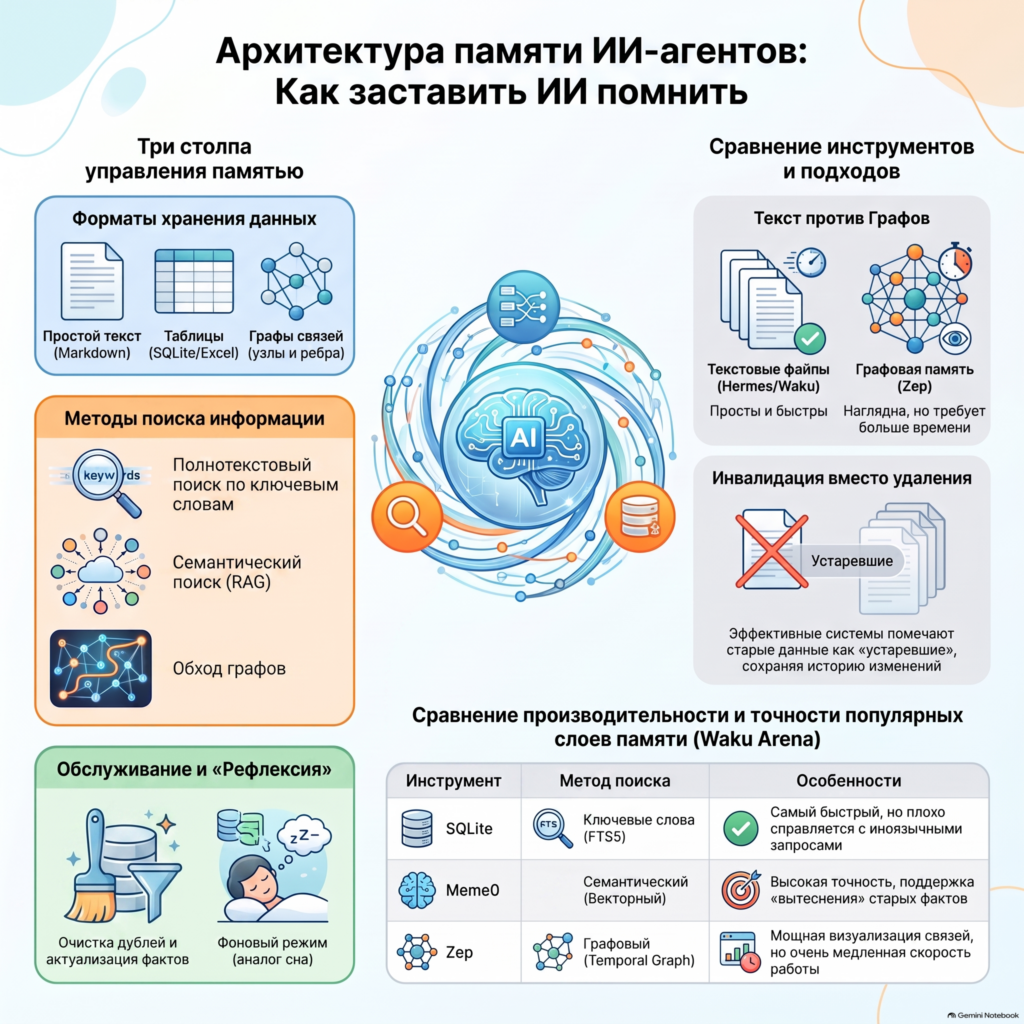
AI agent memory is not a hidden capability of a language model, but an external system for storing, retrieving, and updating context. It allows an agent to continue working across sessions, account for user preferences, use accumulated facts, and avoid repeating the same mistakes.
A practical memory architecture can be divided into three layers: procedural, semantic, and episodic. The first handles skills and instructions, the second handles persistent knowledge, and the third handles event history. This is a useful engineering model, but not a mandatory standard: the specific implementation depends on the task, data volume, and security requirements.
Why a language model starts from a “blank slate” every time
A separate LLM call processes only the context that the application sends to the model in the current request. If conversation history, customer details, or previous work results have not been saved and reloaded, the model cannot use them.
The context window can be compared to an employee's desk. It holds the documents needed right now, but after the session ends, the desk's contents do not automatically become part of the corporate archive.
That is why a full-fledged agent needs an external framework:
- a task execution loop;
- state and history storage;
- a mechanism for retrieving relevant information;
- rules for writing and updating memory;
- tools for performing actions;
- access control and confirmation of critical operations.
It is this architecture, rather than the LLM alone, that makes it possible to create AI assistants and virtual helpers for business, capable of working with long-running processes.
Three layers of AI agent memory
| Layer | What question does it answer | What it stores | Example |
|---|---|---|---|
| Procedural | How should a task be performed? | Instructions, skills, rules for using tools | How to review an application and enter the result into the CRM |
| Semantic | What does the agent know? | Facts, preferences, information about products and processes | The customer prefers to communicate in Russian |
| Episodic | What happened? | Events, actions, messages, and changes over time | The customer requested a quote, and the manager sent an offer |
Procedural memory: how an agent performs work
Procedural memory contains the instructions an agent uses to solve tasks. These may include system rules, skill files, automation workflows, API descriptions, and conditions for handing a request over to a person.
For example, a skill for processing a new application may instruct the agent to:
- extract the name, contact details, and subject of the request;
- check whether there is enough information for qualification;
- ask the missing questions;
- find a suitable service in the knowledge base;
- create a record in the CRM;
- hand over a non-standard or risky request to a manager.
Procedural memory does not necessarily reside in a single database. Small instructions can be kept in the system prompt, while extensive skills can be loaded only when the relevant trigger fires. This approach reduces context size and does not force the model to constantly read instructions unrelated to the current task.
This is how many practical AI automation workflowsare built: an agent receives not an abstract command like “help the customer,” but a specific sequence of actions, permitted tools, and escalation criteria.
Semantic memory: facts about the user and business
Semantic memory stores relatively persistent knowledge: user preferences, company information, service rules, product characteristics, definitions, and decisions that have been made.
Examples of such records:
- the customer operates in Bulgaria and prefers payments in euros;
- the company handles requests in Russian, Bulgarian, and English;
- an order number must be confirmed to return an item;
- the manager must approve discounts above the set limit;
- the report is sent to Telegram every morning and saved in Google Sheets.
For a small agent, a few dozen facts can be stored in Markdown or JSON and loaded in full. As memory grows, this approach becomes costly and inaccurate: too much irrelevant text enters the context.
How to retrieve the right facts
In practice, several retrieval methods are used:
- keyword search — suitable for SKUs, contract numbers, names, codes, and exact wording;
- semantic search — uses embeddings and finds records with similar meanings even when the words do not match;
- metadata search — limits results by customer, project, date, language, or document type;
- hybrid search — combines keywords, semantic similarity, and filters.
The dimensionality of an embedding vector is not a universal property of memory: it depends on the selected model. Therefore, the rule “memory always uses a 1024×1 vector” would be technically incorrect.
Episodic memory: interaction history
Episodic memory records events and the circumstances in which they occurred. It is important not only to capture the fact itself, but also the time, source, participants, and sequence of changes.
For example:
- On August 10, the customer requested a consultation for the first time;
- On August 12, the agent collected the missing data;
- On August 13, the manager sent a commercial offer;
- On August 15, the customer changed the integration requirements;
- On August 17, a new project version was approved.
A simple chat log is not yet high-quality memory. If the entire conversation is passed to the model, the context will grow quickly, while important decisions will be lost among repetitions and service messages.
That is why episodes usually undergo consolidation: the system extracts decisions made, open questions, completed actions, and changed requirements from the history. The consolidation frequency is determined by workload and scenario, not by a universal rule such as “after every 5–10 messages.”
How memory retrieval works before a response
A retrieval gateway is needed between the storage and the model — a software layer that decides which data are needed for a specific request. The name Retrieval Gate conveniently describes this function, although it is not a mandatory industry term.
- The user sends a request.
- The system identifies the user, project, and task type.
- The required instructions and tools are selected from procedural memory.
- Relevant facts are retrieved from semantic memory.
- Related events and recent changes are loaded from episodic memory.
- Data is checked for freshness and access eligibility.
- The selected information is compiled into a compact context for the LLM.
- After a response or action, the result is logged and updates long-term memory if needed.
Without such selection, accumulating data can even worsen the agent's performance: the model receives outdated facts, contradictory instructions, and unnecessary conversation fragments.
How to update memory without losing history
Memory requires maintenance. It is not enough to merely add new records — the system must correct errors, mark outdated information, and delete data according to established rules.
Core operations
- Add: add a new fact or event.
- Update: change an existing record.
- Delete: delete information that should no longer be stored.
- Supersede: replace a fact with a new version while preserving the change history.
- Consolidate: merge duplicate records and extract the key points from several episodes.
If a client first scheduled a meeting for 19:00 and then moved it to 21:00, the agent should use the new time. The old value can remain in the history with a note of when it stopped being valid.
This temporal approach is used in Zep: facts in the graph can have start and end times. But this does not mean that every project requires a graph database.
Markdown, SQL, vectors, or graphs: what to choose
| Storage | When it fits | Limitations |
|---|---|---|
| Markdown, JSON | Small instructions, agent profile, project settings | Difficult to search and update large volumes of data |
| SQLite or PostgreSQL | Messages, events, statuses, users, metadata | An additional mechanism is required for semantic search |
| Vector index | Documents, knowledge base, similar requests, and semantic search | Irrelevant matches are possible; filters and testing are needed |
| Temporal graph | Complex relationships between people, companies, events, and changing facts | More complex development, quality control, and operations |
Graph solutions should not automatically be considered “too slow.” Their suitability depends on the data model and queries. If an agent needs to remember a client's language and recent requests, a regular database is enough. If it needs to track many changing relationships between organizations, documents, and events, a temporal graph may be justified.
For most first versions, a hybrid is a sensible starting point: SQL for events and metadata, file-based instructions for skills, and a semantic index only for materials where semantic search is truly needed.
Key risks of AI agent memory
Incorrect memory is more dangerous than no memory. An incorrect fact can be used repeatedly and affect the agent's subsequent decisions.
- Outdated information. The agent continues to use an old address, price, or agreement.
- False consolidation. A helper model incorrectly extracts the conversation outcome.
- Mixing up users. One client's data ends up in another's context.
- Memory injection. Malicious text is stored as an instruction and affects future actions.
- Excessive storage. The system accumulates personal data without a clear purpose or deletion period.
- No fact provenance. It is impossible to determine who added the record and when.
- Uncontrolled actions. Incorrectly retrieved memory leads to sending an email, changing the CRM, or another external operation.
Therefore, memory must be designed together with security mechanisms: user data separation, least privilege, logging, retention periods, and confirmation of sensitive actions. A practical framework is described in the article on secure AI agent access to email, CRM, and data.
For companies in Bulgaria and other EU countries, it is especially important to consider GDPR. If an agent stores personal data, it is necessary to define in advance the purpose of processing, the information collected, the retention period, rules for correction and deletion, and employee access. Data protection should be built into the architecture, not added after launch.
Which MVP should a business start with
The first memory MVP should not try to remember everything. It is better to choose one process where past context genuinely affects the next step.
For example, for a support agent, the minimum version may include:
- request history linked to the client ID;
- several verifiable facts: language, product, request status;
- instructions for handling typical requests;
- search across the approved knowledge base;
- the date, source, and author of each record;
- manual confirmation of important data changes;
- handover to a manager in case of conflicting facts or low confidence;
- a log of all external agent actions.
After accuracy is verified, you can add automatic consolidation, semantic search, new integrations, and more complex relationships. This gradual approach aligns with the process of AI MVP development and testing: first a limited scenario, then validation with real data, and only after that expanded autonomy.
Conclusion
Memory turns an AI agent from a one-time interface to an LLM into a system that can continue working and account for past experience. But value comes not from the volume of saved messages, but from properly separating instructions, facts, and events, accurately retrieving context, and controlling data updates.
For most business tasks, a complex graph platform is not needed at the first stage. It is enough to define what the agent should remember, where the data comes from, how its freshness is checked, and which actions require human involvement.
If you need to assess the memory architecture for a chatbot, internal assistant, or automation, you can discuss the process and scope of a secure MVP with CenterAI.
Frequently asked questions
Can you simply pass the agent the entire conversation history?
For short conversations, yes. In long-running processes, the history becomes too large and contains a lot of irrelevant data. It is usually supplemented with summaries, structured facts, and selective retrieval of episodes.
Is it necessary to use a vector database?
No. For exact identifiers, statuses, and a small number of facts, SQL or regular files are often sufficient. Vector search is needed when information must be found by meaning in a large body of texts.
Can an agent correct its own memory?
Technically, it can, but important information is better updated from verified sources or after human review. Otherwise, a model error can become a persistent false fact.
How does memory differ from RAG?
RAG retrieves external materials for an answer, usually from documents or a knowledge base. Memory is broader: it also stores user state, event history, instructions, and the results of previous actions. Semantic search can be part of both mechanisms.
Sources and verification
Last checked: 20.08.2026.
- https://console.anthropic.com/docs/en/agents-and-tools/tool-use/memory-tool
- https://console.anthropic.com/docs/en/agents-and-tools/agent-skills/overview
- https://docs.langchain.com/oss/python/langgraph/persistence
- https://docs.mem0.ai/core-concepts/memory-operations/add
- https://help.getzep.com/graph-overview
- https://help.getzep.com/facts
- https://eur-lex.europa.eu/eli/reg/2016/679/oj/eng