


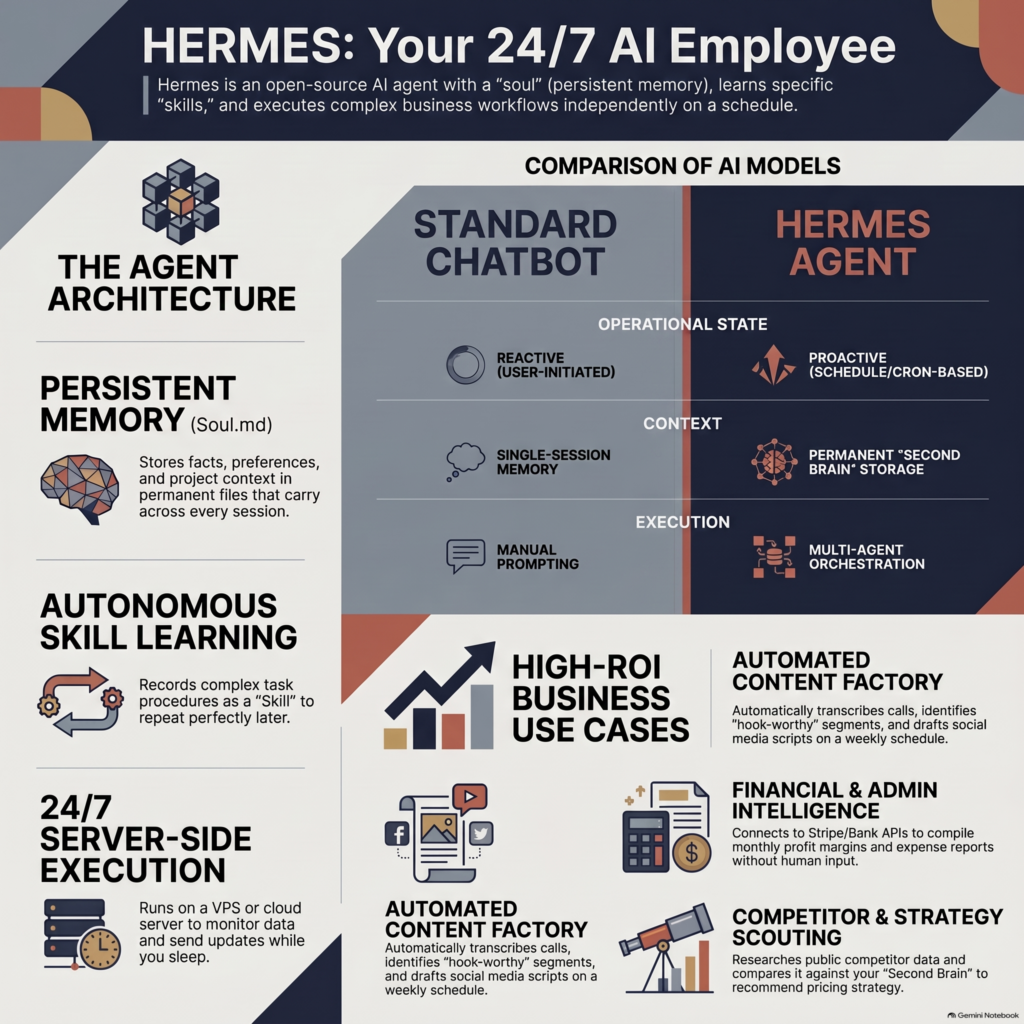
Hermes Agent is an open-source platform by Nous Research for running AI agents that can not only respond in chat but also perform tasks independently: work with files and the internet, run tools, access external services, execute scheduled tasks, and send results to Telegram, Slack, and other channels.
For businesses, the key difference from a regular chatbot lies not in the language model used, but in how the work is organized. Hermes can be turned into an always-on layer between company data, LLMs, external services, and employees: data source → AI analysis → condition check → action → report or handoff to a person.
This makes Hermes particularly interesting where employees regularly perform repetitive intellectual tasks: monitoring sources, preparing reports, sorting information, analyzing documents, running scripts, or collecting data from multiple systems.
What is Hermes Agent in simple terms
Hermes Agent is a runtime environment for an AI agent. It connects a language model with memory, tools, files, a terminal, a browser, task scheduling, and external integrations.
A regular chat with an LLM looks roughly like this:
person → question → model → answer.
And a business process with Hermes may look different:
CRM / API / website / email / documents → Hermes → LLM + tools → check → action → Telegram / Slack / file / another system.
That is why it makes more sense to view Hermes not as another chatbot, but as a type of agent harness — an AI agent runtime environment.
How Hermes differs from a regular AI assistant
Four capabilities are most significant for businesses.
1. Tasks can run without constant human input
Hermes includes its own cron scheduler. You can create a one-time or recurring task in plain language: for example, collect data every morning, analyze changes, and send a brief report to the manager.
A task can run both with and without an LLM. If you only need to check a server's status, retrieve a number from an API, or track a change in a value, Hermes supports script-only tasks without calling a model. This avoids spending tokens where a regular Python or Bash script is sufficient.
2. The agent retains working context
Hermes supports persistent memory across sessions. The agent can store information about the user, work rules, results of previous tasks, and use search across conversation history.
In a business scenario, this means you do not need to paste a long instruction into every request, such as “what products we sell, which sources we consider reliable, and what format the report should have.”
3. Repetitive processes can be packaged as Skills
If a company regularly performs the same intellectual procedure, it can be described as a separate skill. For example:
- check five sources;
- discard irrelevant materials;
- evaluate the findings against specified criteria;
- create a table;
- prepare a brief summary for the manager.
As a result, instead of a long prompt, a repeatable process is used every time. We covered this approach in more detail in the article on AI skills for business processes.
4. One agent can use different interfaces and tools
According to the current documentation, Hermes can work through CLI, Desktop, and gateways for Telegram, Discord, Slack, WhatsApp, Signal, and several other platforms. Through tools, the agent gains access to search, the browser, files, the terminal, memory, media generation, and sub-agents.
For a company, this means that an employee does not need to open a separate AI system. For example, a manager can send a request in Telegram, while the actual processing is handled by an agent on the server.
Which business tasks Hermes is best suited for
Hermes is especially useful when a task requires both AI reasoning and real actions with data or software.
| Task | What Hermes does | Result |
|---|---|---|
| Market monitoring | Checks websites, RSS, APIs, or other sources and assesses changes | Brief report on significant events only |
| Reporting | Receives data, runs calculations, and passes the result to an LLM for explanation | Management summary |
| Content | Collects source materials, classifies them, and prepares drafts | Content plan or materials for an editor |
| Research | Splits the task among sub-agents and combines the findings | Structured analytical material |
| IT and DevOps | Runs commands, checks logs, and monitors system status | Diagnostics or notification |
| Internal assistant | Works with instructions, files, and corporate context | Response or prepared action |
Other typical business automation options are collected in the section CenterAI AI automation scenarios.
Scenario #1: daily analytical report
This is one of the most straightforward MVPs for a company.
Suppose a manager manually checks industry news, competitors, and several professional sources every morning.
The process can be set up as follows:
- At 07:30, cron starts the task.
- Hermes retrieves materials from specified sources.
- Removes duplicates and irrelevant results.
- Evaluates the remaining materials against business criteria.
- Selects, for example, the five most significant changes.
- Explains the impact of each event on the company.
- At 08:00, sends the summary to the manager in Telegram or Slack.
An important point: a good process should not simply retell the internet. The agent needs evaluation criteria. For example: a competitor's price change, a new product launch, a change in legislation, a new major client, or the emergence of technology that could affect cost.
Scenario #2: competitor monitoring
Instead of an employee manually opening competitors' websites every week, Hermes can regularly check selected pages and react only to changes.
A useful workflow looks like this:
competitor websites → data extraction → comparison with the previous state → AI analysis → scoring → notification.
Moreover, not every change requires an LLM. First, regular code can determine whether the price or page text has changed. Only then does the agent analyze the meaning of the change.
This approach reduces costs and the number of false notifications.
Scenario #3: AI analyst for internal data
Hermes can use Python, APIs, and MCP integrations, so it can serve as an interface between an employee and multiple business data sources.
For example:
CRM + ad system + payments → metric calculation → Hermes → deviation explanation → message to the manager.
The user gets not just a set of numbers, but an answer to a business question:
Sales for the week declined not because of fewer leads. There were 4% more leads, but conversion between the first contact and payment fell. The largest deviation comes from source X.
This is no longer a chat with a table, but an automated analytics process.
Scenario #4: human-in-the-loop content process
Hermes can be used for content preparation, but in business it makes more sense to automate not the “write an article” button, but the entire preparation pipeline.
For example:
- the agent gathers materials from selected sources;
- checks which topics have already been used;
- assesses the topic's potential value;
- compiles a factual brief;
- prepares an outline;
- creates a draft;
- hands the material over to an editor;
- after approval, publication or the next automation stage is launched.
In other words, the person remains at the point where an error truly matters.
Scenario #5: IT operations and an internal technical agent
Since Hermes can work with the terminal, scripts, and files, it is suitable for internal technical processes.
For example, you can monitor:
- free space on the server;
- application status;
- errors in logs;
- backup results;
- CI/CD status;
- certificate expiration;
- a sudden change in load.
A simple check is performed by a script without an LLM. If an anomaly is detected, Hermes uses a model to analyze the logs and sends the person an already explained problem.
This is a good example of the principle: LLMs should be used for tasks that require interpretation, not in place of every line of regular code.
What architecture to choose for business
For testing, Hermes can be run locally. For ongoing business processes, it makes more sense to use a dedicated environment — a VPS, virtual machine, or container.
Typical architecture:
VPS → Hermes Agent → LLM API → Skills / Memory → business integrations → Telegram or Slack.
If necessary, you can keep n8n or another workflow engine alongside it:
n8n handles deterministic processes and integrations, while Hermes handles tasks that require reasoning, research, or dynamic selection of next actions.
This is often better than trying to make a single AI agent manage absolutely everything.
Hermes or n8n: what to use
These tools solve different tasks and complement each other well.
| Task | What is preferable |
|---|---|
| Receive a webhook and write data to the CRM | n8n |
| Transfer data between APIs according to fixed rules | n8n |
| Research a question and independently choose sources | Hermes |
| Interpret an unknown situation in advance | Hermes |
| Execute a strictly controlled sequence of actions | n8n |
| Receive data through n8n and conduct complex AI analysis | n8n + Hermes |
In real business, the most resilient approach is usually a hybrid architecture, rather than an attempt to replace traditional automation with a fully autonomous agent.
What data and integrations are needed
Before implementing Hermes, you should define not the model, but the sources and access rights.
Minimum list of questions:
- Where does the agent get its input data?
- Which APIs does it need?
- Which documents or instructions should it know?
- Which actions may it perform automatically?
- Which actions require human approval?
- Where is the result sent?
- What should be logged?
Hermes supports MCP and custom tools, so it can be connected to external systems. But the technical possibility of integration does not mean the agent should be given full access.
The main risk: autonomy without limits
The more tools an AI agent has, the more serious the consequences of an error.
If Hermes can browse the internet, execute commands, modify files, and access corporate systems, you need to consider both ordinary model errors and prompt injection — a situation where a malicious instruction enters the agent's context from an external website, document, or message.
Therefore, a secure architecture should be built around the principle of least privilege.
- Use separate service accounts.
- Do not grant administrative privileges unless necessary.
- Store secrets outside prompts and working files.
- Separate data reading from modification operations.
- Use human approval for critical actions.
- Keep an agent activity log.
- Limit the agent's access to the system and network.
- Be able to disable the integration immediately.
We covered the practical access model in detail in the guide “AI Agent Security: How to Restrict Access to Email, CRM, and Data”.
Should Hermes be given access to a work computer
For a permanent autonomous agent, this is far from always necessary.
If a business process can be performed through APIs, a separate VPS, and service accounts, isolation is usually preferable to direct access to an employee's computer.
For example, an agent that monitors competitors and prepares a daily summary does not need documents from the director's personal folder, browser-saved passwords, or access to the entire corporate network.
Environment isolation does not eliminate risk completely, but it significantly reduces potential damage.
What businesses in the EU should consider
For a company in Bulgaria or another EU country, the technical implementation of an AI agent should be considered alongside GDPR, internal access rules, and applicable EU AI Act requirements.
Special attention is required if the agent handles personal data of customers or employees, confidential documents, or automated decisions that can significantly affect people.
Before launch, you should at least define:
- what data the agent receives;
- which LLM provider it is sent to;
- where logs and memory are stored;
- how long the information is retained;
- who has access to the results;
- whether the agent can independently take external actions.
For projects in the EU, it is also useful to conduct a separate assessment of the AI project against basic security, transparency and documentation requirements.
How much does Hermes cost
Hermes does not have a single “cost per employee”. The economics depend on the architecture.
Costs usually consist of four parts:
- a server or other execution environment;
- LLM API;
- paid external APIs and services;
- development and maintenance of integrations.
LLM costs depend on the chosen model, context size, number of calls and task complexity. Therefore, evaluating a project based on the principle that “one request costs X” is incorrect.
For recurring operations, it is more cost-effective to split tasks: perform simple checks with code, use a compact model for inexpensive classifications, and use a more expensive model only where complex analysis is truly needed.
Where to start: a Hermes MVP for business
The first project should not be “AI that runs the entire company”. It is better to choose one process that is performed regularly, has clear input data and an easily verifiable result.
A good first MVP:
- Choose one task. For example, daily competitor monitoring.
- Define 5–10 sources.
- Formulate significance criteria.
- Deploy Hermes in an isolated environment.
- Connect the LLM and required tools.
- Set up a cron job.
- Send the result to Telegram or Slack.
- At first, have a person review every report.
- After stable operation, formalize the process as a Skill.
Such an MVP allows you to test several things at once: AI quality, execution cost, source reliability, integration security and actual time savings.
At CenterAI, we use a similar implementation approach: first, a specific process is analyzed, then a limited MVP is created, and after testing, the automation is expanded. The stages can be found in the AI automation implementation process.
When Hermes should not be used
Not every process needs an autonomous agent.
Hermes would be overkill if:
- the task is a simple fixed API workflow;
- there is no need for reasoning or dynamic action selection;
- the operation is performed a few times a year;
- the result cannot be objectively verified;
- an error can lead to serious consequences, and there is no human oversight;
- the company does not yet understand what data and permissions the agent will receive.
In such cases, a regular script, an n8n workflow or a semi-automated process may be cheaper and more reliable.
The main principle of implementing autonomous AI agents
The value of Hermes is not that the agent can “do everything”. For business, the opposite approach is more useful: precisely define what exactly the agent is allowed to do independently, what data it receives and at what point a person must confirm the decision.
A properly configured Hermes can become a continuously operating part of a company's infrastructure: collecting data, conducting initial analysis, launching tools, following schedules, and delivering ready-to-use results to employees.
But you should start with one measurable process, rather than trying to create a fully autonomous business.
FAQ
Can Hermes Agent operate around the clock?
Yes. When deployed on an always-on server, Hermes can run tasks through its built-in cron scheduler without an open browser or a running work computer.
Is OpenRouter required?
No. Hermes is not tied to a single LLM provider. The current documentation supports OpenRouter, OpenAI, Anthropic, Google, DeepSeek, and other options, including compatible APIs.
Can Hermes be managed through Telegram?
Yes. Telegram is among the supported gateway channels alongside Slack, Discord, WhatsApp, Signal, and other platforms.
Can Hermes create new skills on its own?
Hermes has a Skills system and a mechanism for saving repeatable procedures. However, in a business environment, skills created by an agent should be reviewed before they gain access to critical data or actions.
Does Hermes replace n8n?
No. n8n is better suited to deterministic integration workflows, while Hermes is for tasks that require reasoning, research, and dynamic action selection. In many projects, using them together is optimal.
Can you run a business fully autonomously through Hermes?
Technically, an agent can be given a broad set of tools, but for a real business, this approach creates unjustified risk. Financial operations, changes to critical data, publishing sensitive content, and other significant actions are best kept under human control.
What to do next
If a company already has recurring work involving data, monitoring, reports, content, or internal systems, it is worth first identifying one process that can be safely delegated to an AI agent.
To assess the architecture, integrations, and a suitable MVP, you can discuss the process with CenterAI.